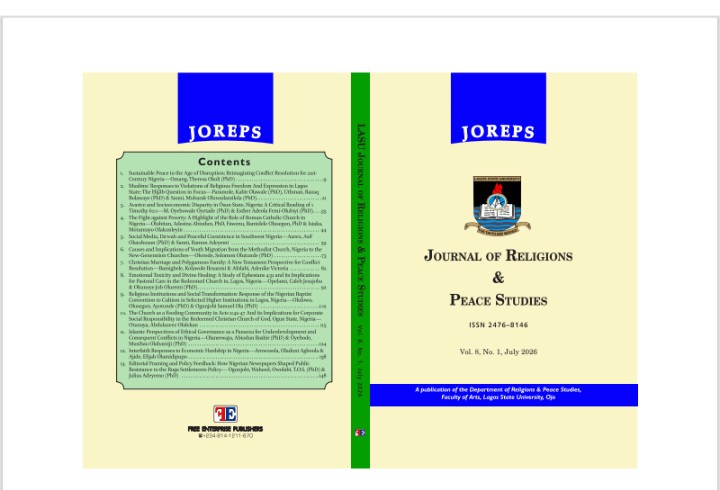
Religious Institutions and Social Transformation: Response of the Nigerian Baptist Convention to Cultism in Selected Higher Institutions in Lagos, Nigeria
DOI:
https://doi.org/10.5281/zenodo.23145541Keywords:
religious institutions, social transformation, cultism, campus ministry, youth engagement,, NigeriaAbstract
This study explores how religious institutions can contribute meaningfully to social transformation, focusing on the response of the Nigerian Baptist Convention to cultism in selected higher institutions in Lagos State. Cultism continues to pose a serious challenge within Nigerian campuses, often mani festing in violence, fear, and a gradual erosion of moral values among students. While much attention has been given to institutional and governmental responses, the role of the church, particularly at the denominational level, has not been sufficiently examined. Adopting a theoretical approach, the study engages key sociological perspectives, including Social Control Theory and the Functionalist view of religion, to explain how faith-based communities influence behavior and shape moral choices. It ar gues that the Nigerian Baptist Convention, through its strong emphasis on biblical teaching, disciple ship, and campus fellowship activities, offers a practical and value-driven alternative to the appeal of cult groups. The paper also reflects on the challenges the church faces, such as limited collaboration with school authorities and the changing realities of student life. Ultimately, the study suggests that when the church is intentional, visible, and contextually responsive, it can play a significant role in reducing cultism and nurturing responsible, value-oriented students.
Downloads