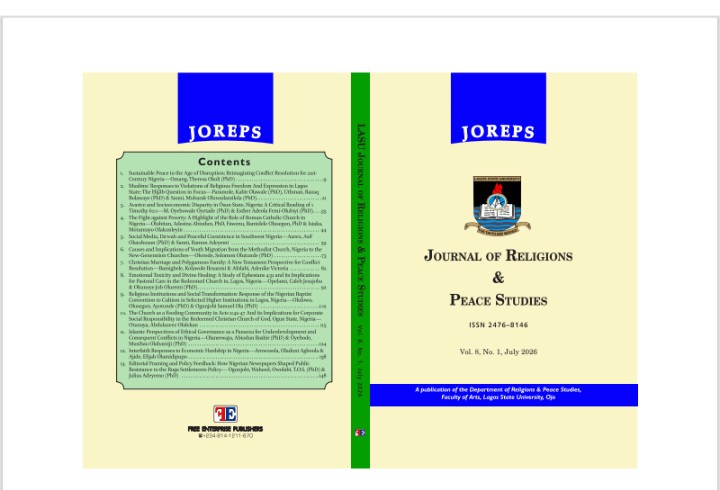
Christian Marriage and Polygamous Family: A New Testament Perspective for Conflict Resolution
DOI:
https://doi.org/10.5281/zenodo.23145348Keywords:
Christian marriage, polygamy, New Testament, conflict resolution, family ethics, African Christianity, pastoral careAbstract
Marriage occupies a foundational position within Christian theology and social organization. Regard ed as a divinely instituted covenant, its integrity is considered central to the health of both the family unit and the broader Christian community. While polygamy is evident in Old Testament narratives, the New Testament presents a clearer ethical framework that upholds monogamy as the normative ideal for Christian living. In many African societies, including Nigeria, polygamy remains cultural ly embedded and socially legitimized, creating significant theological and pastoral tensions within Christian communities. These tensions manifest in areas such as church membership, leadership eli gibility, sacramental participation, inheritance conflicts, and the emotional wellbeing of family mem bers. Despite extensive theological engagement with the institution of marriage, limited scholarly attention has been devoted to the practical application of New Testament principles to conflict res olution within polygamous family systems. This gap is particularly acute in African Christian schol arship, where lived realities often diverge sharply from normative theological prescriptions. This study addresses the tension between biblical ideals and the lived realities of polygamous households among African Christians, using a qualitative theological and hermeneutical methodology. The find ings indicate that while the New Testament does not explicitly legislate against polygamy by name, it consistently promotes monogamy as the ethical standard for Christian marriage through teach ings on covenant fidelity, mutual responsibility, and sacrificial love. Furthermore, the New Testament provides actionable principles including love, justice, mutual responsibility, pastoral sensitivity, and gradual transformation for managing conflicts within polygamous family structures. The study con cludes that effective conflict resolution requires a careful balance between biblical fidelity and cul tural awareness, enabling Christian communities to respond to the complexity of polygamous fami lies with both truth and compassion.
Downloads